| Cat#: TM4749 | Source#: Mouse | Type#: Monoclonal | |
 |
| Applications: WB,IF,ELISA |
|
Reactivity: H,M,R,Mk |
| MW.(KDa): 150 |
Isotype: IgG1,kappa |
|
| his gene encodes a member of the receptor tyrosine kinase family of proteins and the product of the proto-oncogene MET. The encoded preproprotein is proteolytically processed to generate alpha and beta subunits that are linked via disulfide bonds to form the mature receptor. Further processing of the beta subunit results in the formation of the M10 peptide, which has been shown to reduce lung fibrosis. Binding of its ligand, hepatocyte growth factor, induces dimerization and activation of the receptor, which plays a role in cellular survival, embryogenesis, and cellular migration and invasion. Mutations in this gene are associated with papillary renal cell carcinoma, hepatocellular carcinoma, and various head and neck cancers. Amplification and overexpression of this gene are also associated with multiple human cancers |
|
|
| Western Blot |
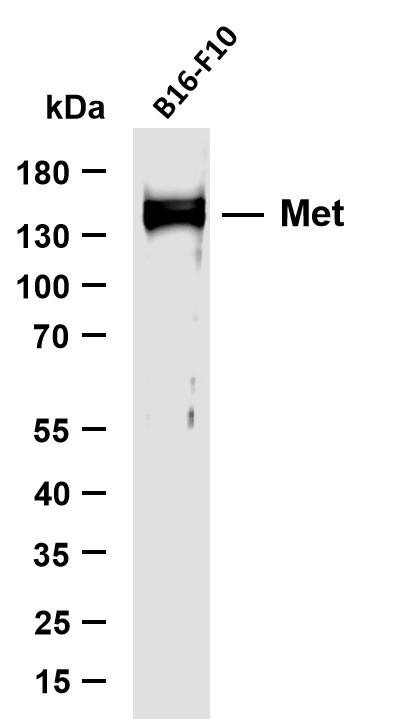
Whole cell lysates were separated by 10% SDS-PAGE, and the membrane was blotted with anti-Met antibody.
|
|
| |
|
| Source |
Synthesized peptide derived from human Met. AA range:1200-1300
|
| Specificity |
This antibody detects endogenous levels of Met. |
| Storage |
Store at -20°C. Stable for one year from the date of shipment. |
| Concentration |
1mg/ml in PBS, pH 7.4, containing 0.02% sodium azide and 50% glycerol. |
| Dilutions |
WB 1:500-2000; IF 1:100-500; ELISA 1:1000-5000
(Optimal dilutions should be determined by the end user)
|
|
| |
|
| MET ; Hepatocyte growth factor receptor ; HGF receptor ; HGF/SF receptor ; Proto-oncogene c-Met ; Scatter factor receptor ; SF receptor ; Tyrosine-protein kinase Met |
| |
|
|
|
|
| Size: |
50μL ¥1000
100μL ¥1800 |
|
| New Product: |
|
|
|
| 直接下单: |
|
立即下单
|
|

